
Reject STA Prop 1

The debate over renewing Spokane Transit Authority’s (STA) temporary 0.2% sales tax through 2048 in the August 4th primary election is not a question of whether public transit is important. It is a question of whether this additional tax revenue is necessary to maintain current service levels and whether STA responsibly manages the public dollars it already receives.
STA asserts on its website “most money would go toward maintaining current service”1 if the ballot measure is approved. Financial analysis of their statements raises serious questions about the claim, as the funds have not been used for it since the tax was imposed. While you might think the daily sight of empty STA buses would answer the question of the agency’s fiscal responsibility, in truth, the situation is actually much worse.
The 2016 Tax Has Not Been Needed
The temporary 0.2% sales tax approved in 2016 was intended to “improve and expand transit service.”2 Data shows the revenue has not been necessary for either purpose, instead flowing into the agency’s reserves. Loss of the 0.2% sales tax authorization will still leave STA with substantial public funding.
STA reserves have grown $234M since tax implemented, faster than $169M in revenue generated by the tax.
Unrestricted reserves for STA now total over $274.M.
STA will receive ~$3B revenue through 2048 from permanent 0.6% sales tax allocation whether STA Prop 1 passes or not.

STA Has Not Shown Fiscal Responsibility
The second question voters should consider is whether STA is providing good value for the money we provide it. The answer is unequivocally no. In the last decade, STA has significantly increased staffing, its farebox recovery has collapsed and the cost of ridership has grown dramatically. Ridership trends raise concerns about the potential of STA to ever reaching economic viability.
STA staffing, which was steady prior to the 2016 tax, has grown by 56%.
Farebox recovery has declined to 8.79% since 2017, significantly below STA’s own, meager 20% goal. Recent pilot programs threaten to further erode the figure.
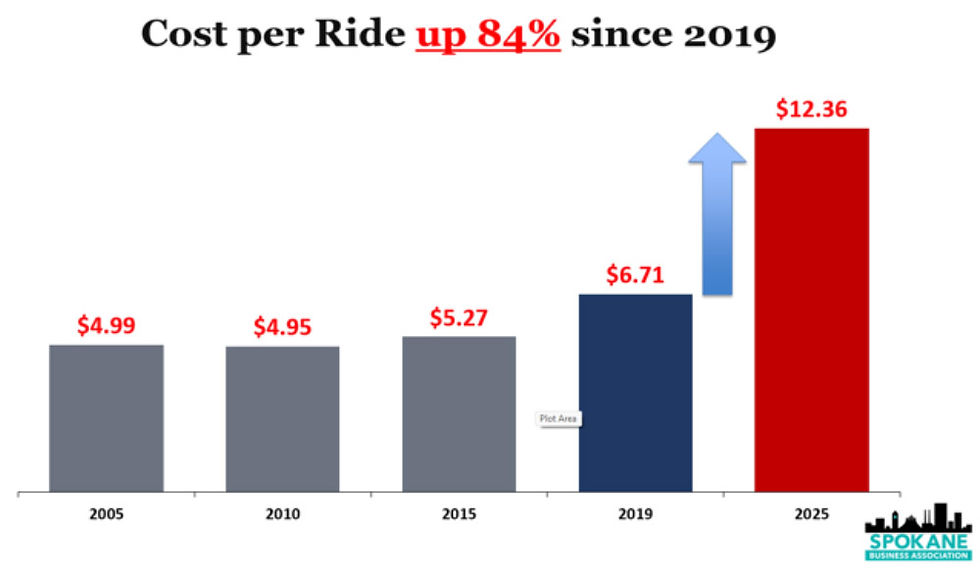
Cost of ridership has skyrocketed, increasing 84% since 2019.
Despite extensive free and reduced fare programs, total ridership over the last 10-year period is flat and has decreased 19% when calculated on a per capita basis.

The temporary 0.2% tax is clearly not required to sustain the current level of service. Furthermore, it will remain in place through Dec 31, 2028 giving STA 2½ years to increase revenues and/or decrease expenses, if any changes are needed at all. When was the last time you were given 2+ year notice about a decrease in your income?
STA representatives acknowledge the agency has no intention to achieve break-even operations and have stated disapproval renewal would not force immediate changes to service (see STA in its own words). The decision on STA Prop 1 is not a question of whether there should be public transit. STA, for all its failings, already has the resources to maintain current service levels.
A No vote on STA Prop 1 sends a clear message the community expects accountability and responsible stewardship of public funds. It is a message Spokane Transit Authority badly needs.
Vote No on STA Prop 1 by August 4th in the primary election.
Source Documents & Additional Information
Sources: Thanks and credit to the Spokane Business Association (SBA) and its President, Gavin Cooley for analyzing the data and producing charts to clearly explain it. It is the product of his17-years of experience as the City of Spokane’s Chief Financial Officer, at testament to his commitment to fixing problems in our community and the result of countless hours gathering, analyzing and synthesizing some very exciting financial data. The full presentation as well as sourcing information is provided below with permission of SBA. In some cases, formatting and wording have been altered from the original SBA document in the graphics below for the sake of clarity, but underlying source data and conclusions are unchanged.
1 STA PROPOSITION 1, Spokane Transit Authority, June 28, 2026, https://www.spokanetransit.com/sta-proposition-1/.
2 Resolution No. 742-16. Spokane Transit Authority, Sokane, WA, Nov 8, 2016, p. 2, https://mrsc.org/getmedia/afbeea7f-0a88-4736-91b0-90ef96e7c719/s77t7staR742-16.pdf.
STA in its own words
· STA has no intent to try and break even as an operation
· STA states disapproval of the renewal would not force immediate changes to service
Background information: STA currently receives 0.8% sales tax revenue, which is a made up of the 0.2% temporary tax approved by voters in 2016 in combination with a 0.6% sales tax rate that is not subject to renewal (for more information on the 0.6% rate, see History of Transit in Spokane). All taxable purchases in the Public Transportation Benefit Area (PTBA) are subject to the sales tax (link to PTBA map).

1 Comment